Vegan Protein vs Whey: What the Evidence Actually Says
Soy actually outscores whey on the modern protein-quality metric, pea and rice do not, and at the budget end of the UK market plant now costs less per gram of protein. A head to head on the evidence rather than the marketing.
Kevin, founder of WheyWise
Quick answer
The honest answer is that it depends which plant protein, and the ranking is not the one most articles give. On DIAAS, the modern protein-quality score, soy scores 91 and whey scores 85, so soy is not whey's poor relation. Pea at 70 and rice at 47 genuinely are behind. On price, plant has actually moved ahead at the budget end: WheyWise checks put the cheapest UK vegan protein at about 21p per 25g of protein against about 32p for the cheapest unambiguous whey, because cheap soy isolate runs around 90g of protein per 100g while cheap whey concentrate runs 68g to 72g. On muscle, a 2025 meta-analysis of 30 trials found a small advantage to animal protein overall, and no difference at all when the plant protein was soy.
Is vegan protein as good as whey?
It depends entirely on which plant protein, and the answer is not the one most comparison articles give. Soy protein scores 91 on DIAAS, the modern protein-quality metric, while whey scores 85. Pea scores 70 and rice scores 47. So the honest version is that one plant protein is quality-competitive with whey, and the two most commonly sold ones are not.
That single distinction explains most of the confusion in this debate. An article that says plant protein is just as good is usually thinking about soy. An article that says plant protein is clearly worse is usually thinking about pea or rice. Both are right about their own subject and wrong about the category.
Vegan protein vs whey, side by side
| Whey | Soy | Pea | Rice | |
|---|---|---|---|---|
| DIAAS score | 85 | 91 | 70 | 47 |
| Limiting amino acid | Histidine | Met + Cys | Met + Cys | Lysine |
| Typical isolate protein | 72-84% | 61-91% | 77-81% | 79% |
| FAO quality class | High | High | Low | Low |
| Cheapest UK, per 25g protein | 32p | 21p | 23p | n/a |
DIAAS, limiting amino acids and isolate protein ranges from Herreman et al. 2020 and Gorissen et al. 2018. FAO classes: 100 and above excellent, 75 to 99 high, below 75 no quality claim permitted. Prices checked across the UK retailers we track.
The whey side
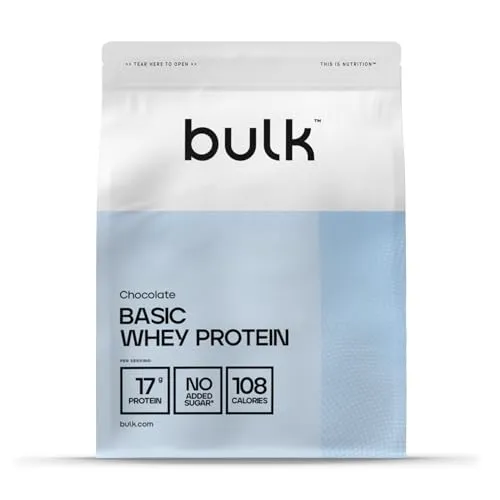
Bulk Basic Whey Protein
1.25kg bag
The default for a reason, and the reason is leucine density and texture rather than protein quality. At about 50p per 25g of protein it is mid-priced: cheaper whey exists at around 32p, and cheaper plant protein at around 21p.
or compare all UK prices →The whey side
Bulk Basic Whey Protein
1.25kg bagPros
- + About 11% leucine as a share of protein, the highest of any common protein source, so the scoop needed to trigger muscle protein synthesis is the smallest
- + 72g of protein per 100g at about 50p per 25g of protein
- + Mixes and tastes like a milkshake with no grittiness, which is the practical gap plant proteins still have to close
Cons
- – DIAAS 85 is below soy at 91, because whey is limited by histidine
- – Contains lactose, so it is unsuitable if you are avoiding dairy for any reason
- – About 9.5kg of CO2 equivalent per 100g of protein for milk against 0.44kg for peas, though whey is a cheese co-product so it does not carry the full dairy footprint
●Nutrition per scoop · 16.8g protein in 30g▼
Protein makes up 56%
of this 30g scoop · 92 kcal total
The plant side
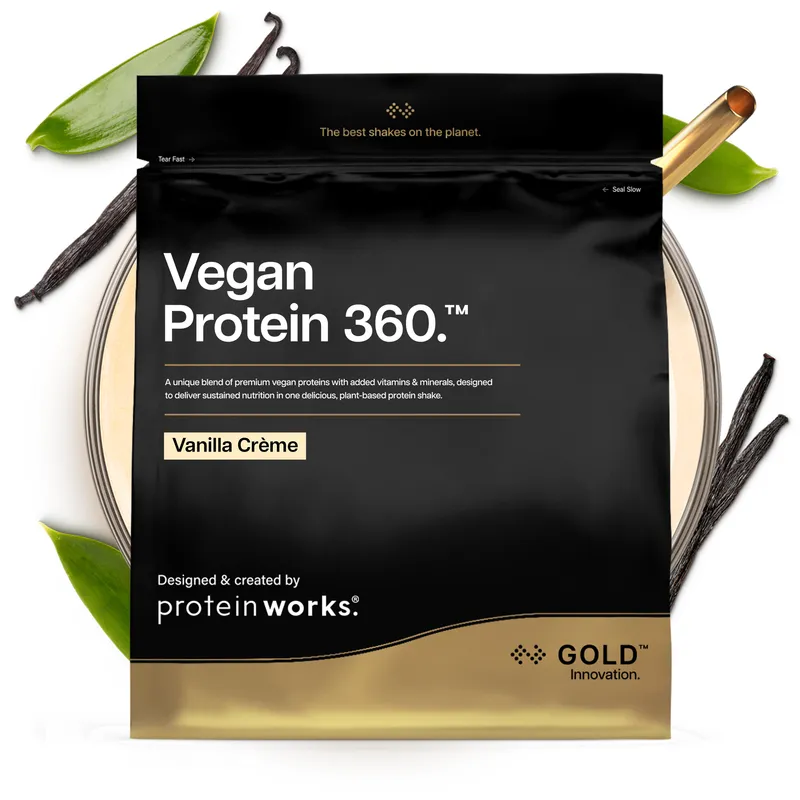
Protein Works Vegan Protein 360 Gold
1kg bag
A blend rather than a single source, which is the right way to buy plant protein. At about 41p per 25g of protein and 82g per 100g it makes the price argument for switching without needing the quality argument.
or compare all UK prices →The plant side
Pros
- + 82g of protein per 100g, higher than most whey concentrates, which is why plant protein competes on cost per gram despite costing more per kilo
- + About 41p per 25g of protein, undercutting the whey card above by roughly 9p a serving
- + A blend rather than single-source pea, which matters because pea alone scores DIAAS 70 and is limited by methionine and cysteine
Cons
- – Every plant protein needs a larger scoop than whey to deliver the same leucine, roughly 37% more in the case of soy
- – Texture is the honest weak point: plant proteins are grittier and earthier than whey and no brand has fully solved it
●Nutrition per scoop · 24.6g protein in 30g▼
Protein makes up 82%
of this 30g scoop · 109 kcal total
Which is higher quality protein?
Protein quality is measured by DIAAS, the Digestible Indispensable Amino Acid Score, which replaced the older PDCAAS. The difference matters here: PDCAAS is capped at 1.0, so anything excellent gets the same top mark and the metric cannot separate whey from soy. DIAAS is uncapped, which is why it produces the more informative ranking.
Herreman and colleagues published the reference values in 2020: casein 117, potato 100, soy 91, whey 85, pea 70, hemp 54, rice 47. The FAO thresholds are 100 and above for an excellent-quality claim, 75 to 99 for high quality, and below 75 means no protein-quality claim may be made at all.
Two things in that list surprise people. Soy outscores whey. And whey does not reach the excellent threshold, because it is limited by histidine. Casein, the other dairy protein, comfortably does at 117.
Blending helps but has a ceiling. An optimised pea and rice blend tops out at DIAAS 84 at roughly 59% pea to 41% rice, which is still below soy on its own. Pea and wheat reaches 85, soy and canola 92. Blending fixes a limiting amino acid; it does not manufacture whey, and it does not need to, because soy already sits above whey without help.
Which builds more muscle?
The best available answer comes from a 2025 meta-analysis in Nutrition Reviews that pooled 30 randomised controlled trials covering 1,538 participants. It found a small advantage to animal protein for muscle mass, a standardised mean difference of 0.20, which was larger in younger adults than older ones. It found no difference for strength across 14 trials, and none for physical performance across 5.
The important detail is the subgroup. When the plant protein being compared was specifically soy, the difference was 0.02, which is statistically and practically nothing. The small overall animal advantage is being driven by the weaker plant sources, not by plant protein as a category.
The individual trials line up with that. Lynch and colleagues in 2020 put 48 untrained adults through 12 weeks of resistance training on either 19g of whey or 26g of soy, doses chosen to match leucine at 2g. Lean body mass rose 1.5kg on whey and 1.2kg on soy, with no significant difference between groups. Banaszek in 2019 found similar outcomes between whey and pea across 8 weeks of high-intensity functional training.
Babault in 2015 randomised 161 men to 50g a day of pea, whey or placebo for 12 weeks. Biceps thickness rose 15.3% on whey, 13.4% on pea and 10.7% on placebo, and the difference between groups was not statistically significant at P = 0.09. That study was funded by Roquette, a pea protein producer, with three employee authors, which is worth knowing when you read it.
Which is cheaper in the UK right now?
Plant, at the budget end, which is a genuine reversal. WheyWise price checks put the cheapest vegan protein we track at about 21p per 25g of protein against about 32p for the cheapest product that is unambiguously a whey. Plant protein used to carry a premium. At the bottom of the UK market it no longer does, although branded blends still can: we found Huel protein powder costing about the same per gram of protein as a 1kg bag of whey.
The mechanism is protein density rather than a change in raw ingredient cost. Cheap soy isolate runs around 90g of protein per 100g, and cheap pea isolate 80g to 86g, while cheap whey concentrate runs 68g to 72g. Whey costs less per kilogram of powder; plant protein delivers considerably more protein per kilogram, and at the budget end that more than closes the gap.
That parity does not hold everywhere in the market. Within a single brand whey is often still cheaper: Bulk Basic Whey at about 50p per 25g of protein undercuts Bulk Vegan Protein Powder at about 67p. The parity is a feature of the cheapest end of the market, where plant isolates are sold in large plain bags at high purity.
You can check either side against current prices on the vegan protein comparison and the whey concentrate comparison, or line two specific products up in the protein comparison tool.
Do plant proteins contain more heavy metals?
Plant proteins do generally test higher for heavy metals than whey, because plants take up lead and cadmium from soil and dairy does not to the same degree. That much is not disputed.
What is disputed is what it means. The Clean Label Project reports that generated most of the headlines here drew formal objections from three industry bodies. The Council for Responsible Nutrition argued that detection is not the same as health risk and that California's Proposition 65 thresholds embed a thousand-fold safety factor. The Consumer Healthcare Products Association pointed out that the reports were not peer reviewed, that the Proposition 65 trigger of 0.5 micrograms sits far below the FDA's 12.5 micrograms per day, and that the organisation both tests products and sells certification to them. The Natural Products Association called it a sham.
Those objections come from bodies that represent the manufacturers being tested, so they are not neutral either. The reasonable position for a buyer is that this is a real difference in kind but a small one in degree, that testing thresholds designed to trigger a warning label are not the same as a level of harm, and that if it concerns you, third-party testing schemes like Informed Sport exist and some plant brands carry them.
Why does vegan protein taste gritty?
Because the particles are larger and less soluble than whey's. Whey dissolves close to completely in water; pea and rice proteins hold a suspension, which is what the tongue reads as chalky or gritty. Pea also carries a distinctly earthy background note that flavouring has to cover rather than complement, which is why chocolate and coffee flavours work better in plant protein than vanilla or plain.
Blends and modern processing have narrowed this a lot, and clear plant proteins avoid it entirely by going down a juice-style route rather than a milkshake one. But it is still the honest weak point, and it is the single most common reason people who switch on principle switch back in practice. Buy a small bag first.
Who should choose which
Stay on whey if you eat dairy, tolerate it fine, and are optimising for muscle. The leucine density is real, the texture is better, and there is no argument that will make a switch improve your training outcomes.
Choose plant if you are dairy-free, if whey does not sit well with you, or if the footprint matters: peas come in at about 0.44kg of CO2 equivalent per 100g of protein against 9.5kg for milk, though whey is a co-product of cheese making so it does not carry the whole dairy footprint on its own.
If you do choose plant, choose soy or a blend. That is the practical conclusion of every section above. Soy matches whey on quality and price, blends land in the low 80s on DIAAS, and single-source pea or rice is the one option that genuinely costs you something. If you go single-source anyway, increase the scoop by roughly a third.
If you have already decided on plant and want current picks rather than the comparison, see the best vegan protein powder in the UK. If dairy avoidance is the driver, we cover the options in dairy-free protein powder. And if you are not sure which type suits you at all, the protein finder narrows it to three picks in about a minute.
Frequently asked questions
Is vegan protein as good as whey for building muscle?
For soy, the evidence says yes. A 2025 meta-analysis in Nutrition Reviews pooling 30 randomised trials and 1,538 participants found a small advantage to animal protein for muscle mass overall, but when the plant protein was specifically soy the difference was effectively zero. It found no difference at all for strength across 14 trials. For pea and rice the evidence base is thinner and the protein quality scores are genuinely lower.
Is vegan protein cheaper than whey in the UK?
At the budget end, yes. The cheapest vegan protein we track works out at about 21p per 25g of protein against about 32p for the cheapest product that is unambiguously a whey. The reason is protein density: cheap soy isolate runs around 90g of protein per 100g while cheap whey concentrate runs 68g to 72g, so the plant powder delivers more protein per kilogram. Higher up the market whey is often still cheaper within a given brand.
How much more vegan protein do I need to match a whey serving?
For soy, about 37% more powder. In a 2020 trial by Lynch and colleagues the doses used to deliver a matched 2g of leucine were 19g of whey against 26g of soy. Whey carries about 11% leucine as a share of protein, which is the highest of any common source, so every plant protein needs a larger scoop to hit the same leucine content.
Does soy protein really score higher than whey?
On DIAAS, yes. Herreman and colleagues in 2020 reported soy at 91 and whey at 85, with casein at 117 and potato at 100. Whey is limited by histidine, which is what pulls its score down. This is worth knowing because the older PDCAAS metric caps at 1.0, so it shows whey and soy as closer than DIAAS does. Pea at 70 and rice at 47 are well behind on either metric.
Should I switch from whey to vegan protein?
Switch if you are dairy-free, if whey does not agree with you, or if the environmental footprint matters to you: peas produce about 0.44kg of CO2 equivalent per 100g of protein against 9.5kg for milk. If you switch, choose soy or a blend rather than single-source pea or rice, because that is where the quality evidence holds up. If none of those apply, there is no performance reason to move.
Related reading
Why Does My Protein Bar Taste Artificial? Ingredients to Avoid
Why protein bars taste artificial and cause bloating: maltitol, sucralose, polydextrose, chicory fibre, IMO and collagen explained, plus which Myprotein, Protein Works and Bulk bars skip sweeteners, palm oil and seed oils. Ingredient lists.
8 min read
Can You Mix Creatine With Protein Powder? Cost Per Day
Whether creatine and protein powder can go in the same shake, what the research says about taking them together, when to drink it, and what the combination costs per day, checked September 2026.
6 min read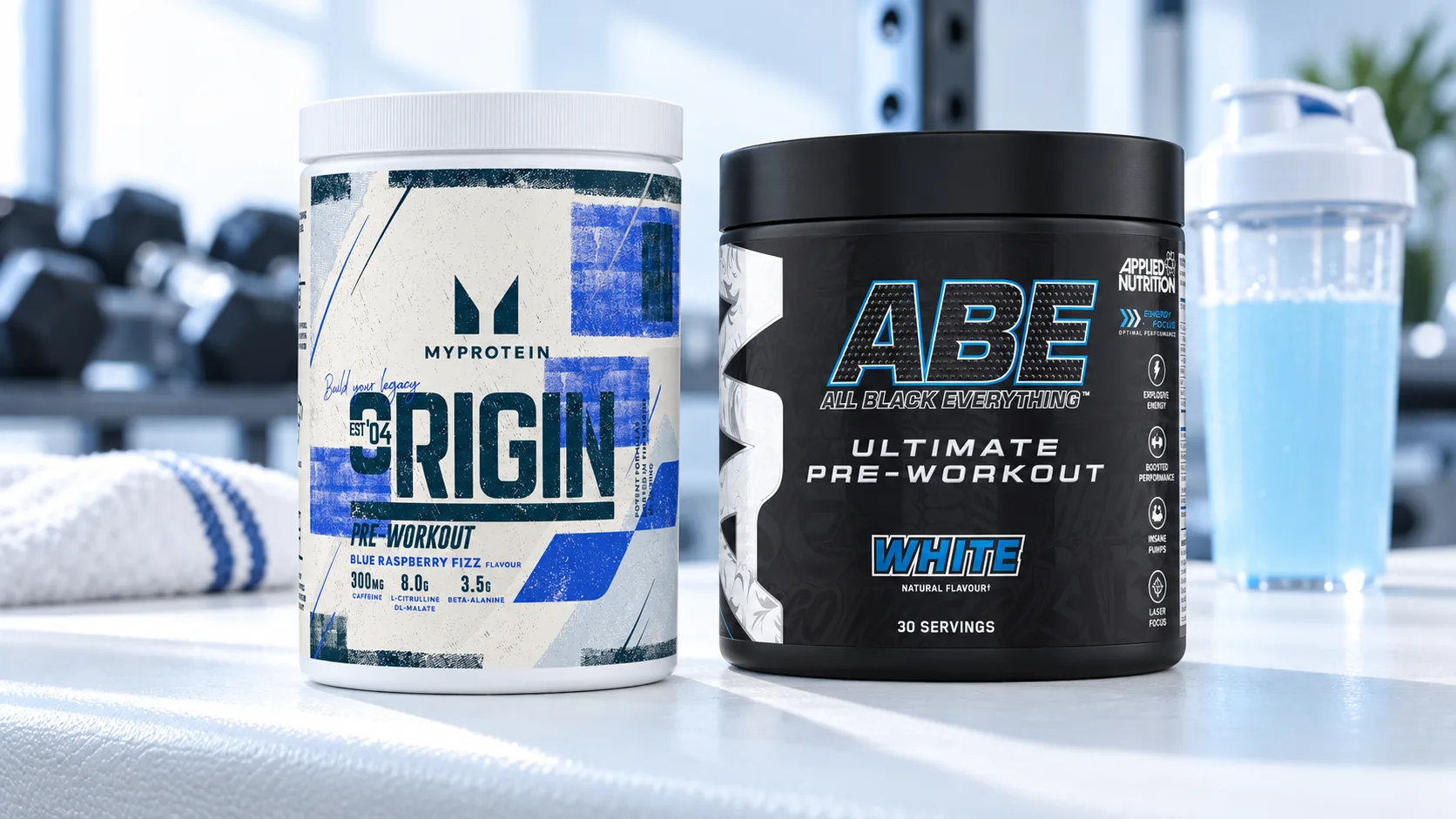
What Is in Pre-Workout, and What Does It Cost?
The ingredients in a typical UK pre-workout, what the evidence says caffeine, citrulline and beta-alanine do, when to take it, and the price per serving of Applied Nutrition ABE and Myprotein Origin, checked September 2026.
7 min readFind your cheapest protein
717 products compared from 180 brands
Sorted by best value per 25g of protein.
Compare all products