Quick answer
Collagen protein does count towards your daily protein, but only up to a point, because it contains no tryptophan and little leucine. A 2019 analysis found collagen can make up as much as 36% of daily protein in a typical American diet while still meeting essential amino acid needs, so a collagen scoop on top of normal meals is fine. WheyWise read the study tables, and for building muscle a complete protein such as Myprotein Clear Whey does the job collagen cannot: in older women, whey raised longer-term muscle protein synthesis and collagen did not.
Collagen is the protein that makes up much of the body's connective tissue, around 25% to 30% of all body protein according to Paul et al., 2019, and it counts as protein on a nutrition label. It is missing one essential amino acid, tryptophan, and is low in leucine, which is why it can top up your protein total but cannot stand in for whey.
What is collagen protein?
Collagen protein is a protein rich in glycine, proline and hydroxyproline and short on several essential amino acids. In Paul et al., 2019, the collagen peptides analysed contained no tryptophan at all, so under the PDCAAS scoring method collagen counts as an incomplete protein. Supplements sell it as collagen peptides, from porcine, bovine or marine sources in that study. Collagen comes from animal tissue, so it is not vegetarian.
Does collagen count towards your daily protein?
Yes, up to about a third of it. Paul et al. calculated that collagen peptides could make up as much as 36% of the protein in the standard American diet while still meeting every essential amino acid requirement, because the rest of the diet carries a surplus. The table shows why collagen cannot do the job on its own.
| Per 100g of protein | Collagen peptides | Standard diet protein mix |
|---|---|---|
| Tryptophan | 0.00g | 1.20g |
| Leucine | 2.51g | 8.07g |
| Lysine | 4.31g | 6.97g |
| Methionine and cysteine | 0.72g | 3.68g |
Source: Paul et al., 2019, Table 2: porcine collagen peptides (sample D) against the protein mix of the standard American diet.
Does collagen build muscle like whey?
No, and a direct trial shows the gap. In Oikawa et al., 2020, 22 healthy older women took 30g of whey or 30g of collagen twice a day for 6 days. Whey raised muscle protein synthesis both at rest and after exercise, while collagen raised it acutely only after exercise and did not lift longer-term muscle protein synthesis above baseline. Collagen also has under a third of the leucine of a normal protein mix, 2.51g against 8.07g per 100g of protein.
Should you count collagen or buy whey?
Count a collagen scoop towards your daily total if most of your protein still comes from meat, fish, dairy, eggs or soy. Do not rely on it as your main shake if your goal is muscle. If you like collagen because it mixes into a light, clear drink, a clear whey gives you the same style with a complete protein: Myprotein Clear Whey has 79g of protein per 100g. For collagen products themselves, see the best collagen UK guide, and compare clear wheys on the clear whey price comparison.
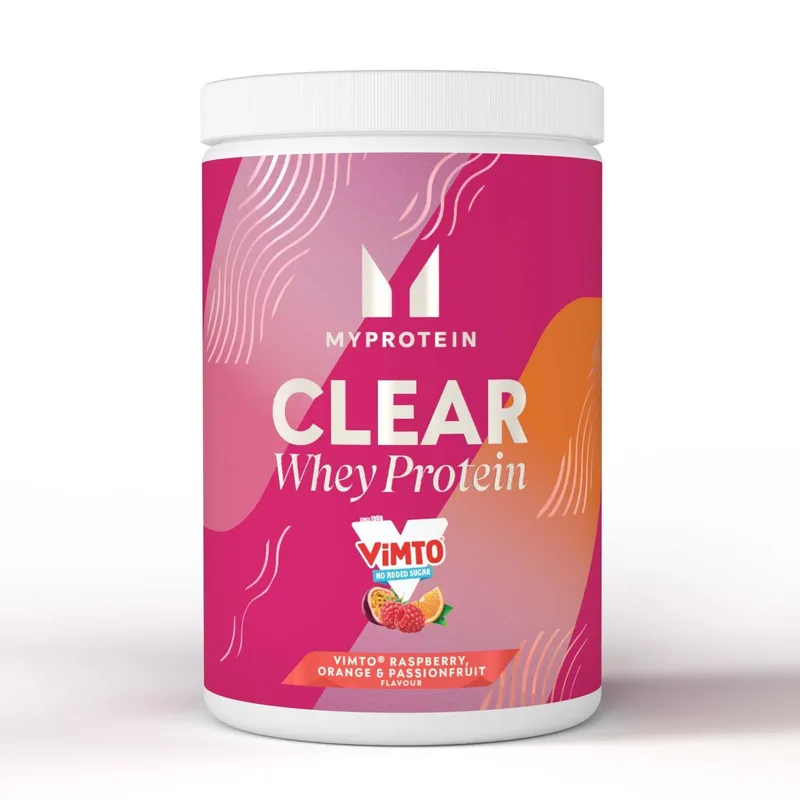
Clear like collagen, complete like whey
MyProtein Clear Whey Protein Powder
500g bag
The swap for collagen drinkers who want a light, clear shake that actually supports muscle.
or compare all UK prices →Clear like collagen, complete like whey
Pros
- + 79g of protein per 100g, 20g in a 25g serving, on myprotein.com
- + A complete whey protein, unlike collagen
- + Suitable for vegetarians, according to myprotein.com
Cons
- – £1.81 per 25g of protein in the 875g bag at £49.99, dearer than milky whey
- – Myprotein's nutrition panel does not say which flavour it is for
●Nutrition per scoop · 19.5g protein in 25g▼
Protein makes up 78%
of this 25g scoop · 84 kcal total
Frequently asked questions
Is collagen a complete protein?
No. Collagen contains no tryptophan, one of the nine essential amino acids, so it is classed as an incomplete protein under the PDCAAS scoring method. Paul et al., 2019 list 0.00g of tryptophan per 100g in the collagen peptides they analysed.
How much of my protein can come from collagen?
Paul et al., 2019 calculated that collagen peptides could replace up to 36% of the protein in the standard American diet while every essential amino acid requirement was still met. The 2.5g to 15g a day used in collagen studies is well below that ceiling, the authors note.
Is collagen better than whey for muscle?
No. In Oikawa et al., 2020, 22 older women took 30g of whey or 30g of collagen twice a day for 6 days. Whey raised muscle protein synthesis at rest and after exercise, while collagen did not raise longer-term muscle protein synthesis above baseline. For muscle, choose whey or another complete protein.